A cuisine records what a society knows how to grow, raise, gather and transform. Read closely, it shows which resources an economy could build on. This is the proposition of Flavours of Influence, and the starting point of our teaching.
Chapter 4 of Flavours of Influence puts the approach to the test on a single question: where should Cameroon look for the animal protein it needs?
The cookbook as evidence
16 / 40
basic ingredients of Cameroonian cuisine are animal resources, according to Le Grand livre de la cuisine camerounaise.
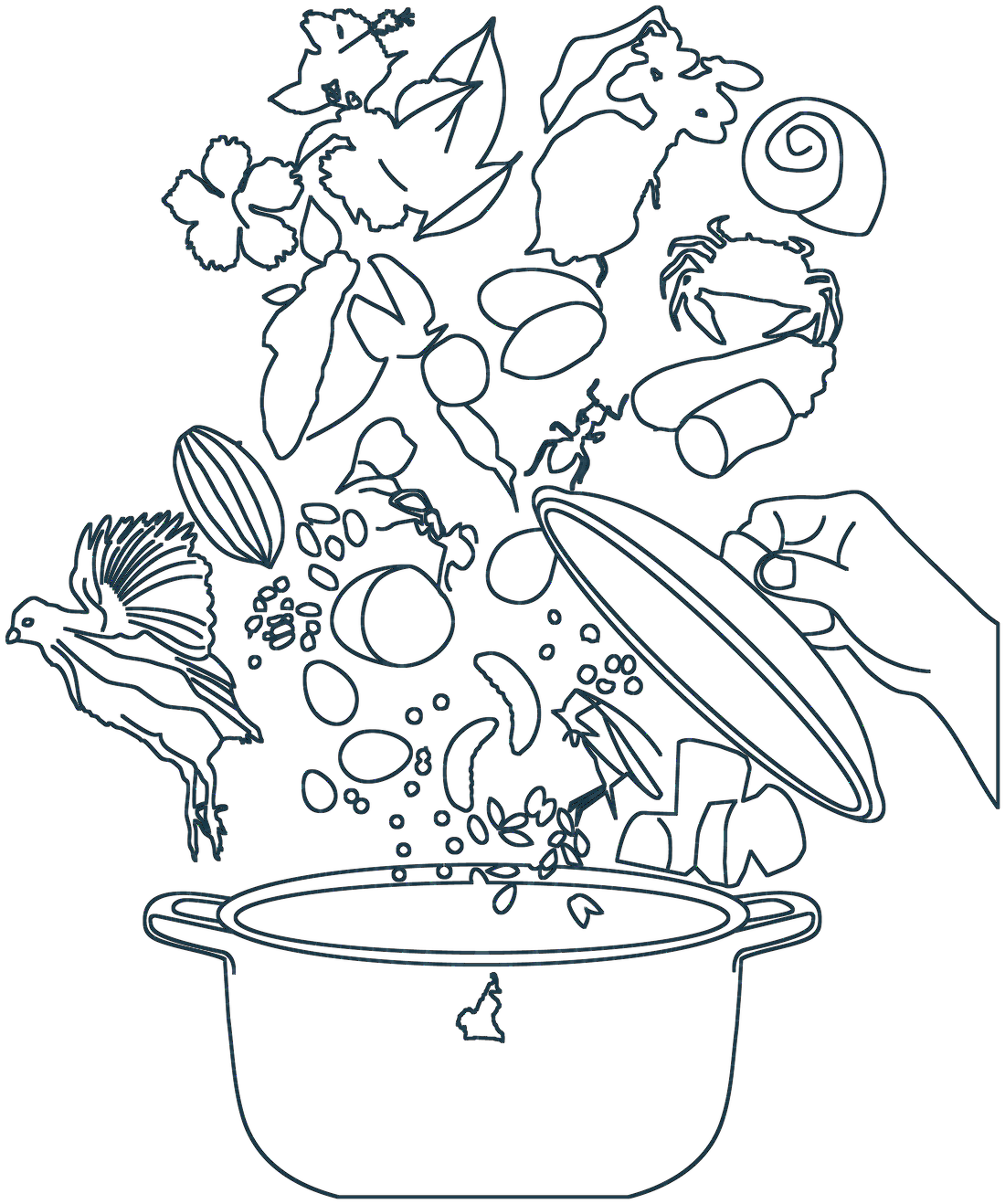
Sixteen of the forty basic ingredients listed in Le Grand Livre de la Cuisine Camerounaise are animal resources, from beef, poultry and fish to snails, crabs, termites and caterpillars. Yet livestock policy has long prioritised conventional cattle, poultry and pig production, while so-called “non-conventional” resources remain marginal.
Consider pre-war Ukraine. Its competitive livestock industry was built around its geography, cereals, agricultural systems and scientific capabilities. What if Ukraine had to import tropical ingredients to feed its chickens, or raise giant frogs, termites and aulacodes through the winter? Would it remain competitive?
Why, then, should tropical countries be expected to reproduce production systems designed for temperate environments?
The alternative is not to abandon conventional livestock farming, but to rethink production around locally available resources, ecological conditions and food cultures. Cameroon has decades of research and practical experimentation with species such as aulacodes, guinea pigs and snails. Insect farming offers further possibilities for food, animal feed and circular production systems.
The opportunity is to connect what already exists (biodiversity, culinary knowledge, research, farming capabilities and market demand) into new economic possibilities.
“Price is not everything; geography sheds a different light and reveals opportunities.”
Another path to the same word
In Agri-Culture: Reconnecting People, Land and Nature (Earthscan, 2002), Jules Pretty argued for reconnecting farming with nature and with the communities that live from it. Flavours of Influence reaches it from the kitchen. Here, cuisine is the evidence: what people cook shows which resources can become an economy.
02 · Where it is taught
Two complementary modules.
The course turns this reading into a method. Two complementary modules, for professionals, future professionals and decision-makers across gastronomy, agriculture and hospitality, from final-year bachelor’s students onward. Taught in person. Each module stands on its own; the two work well in sequence.
Module 1
From Agriculture to Agri-Culture
How to read an economy through food
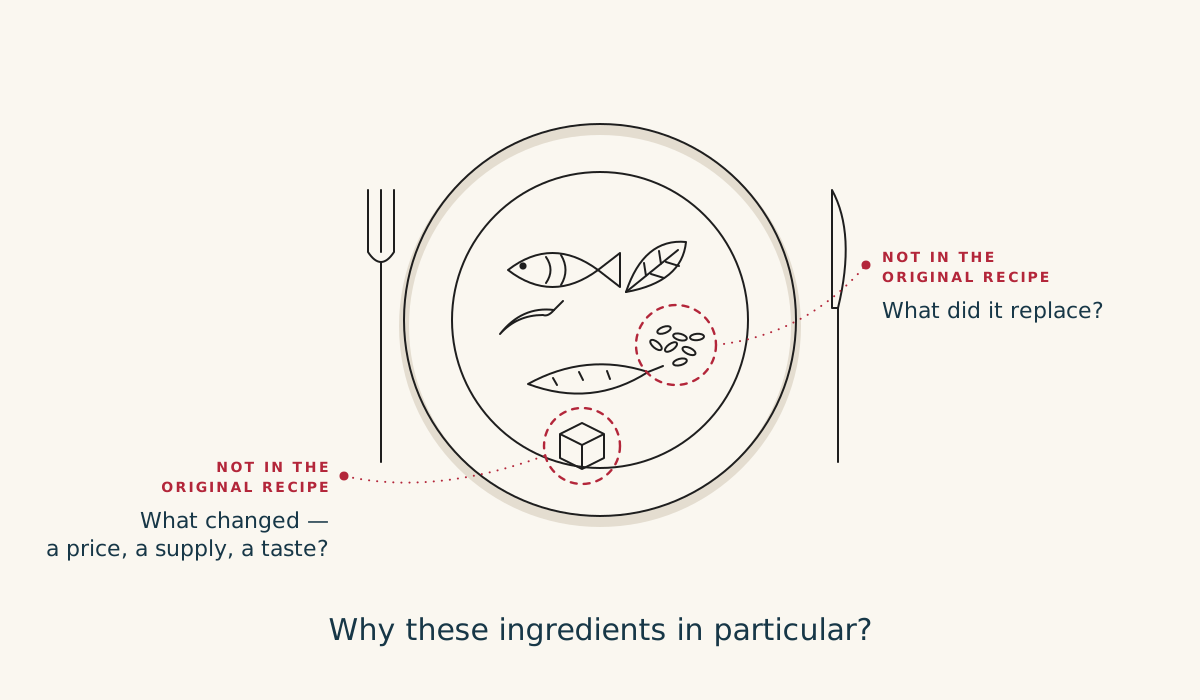
Participants work backwards from a dish to the ingredients, territories, knowledge and transformations behind it, then examine what these reveal about today’s economy.
Traditional does not necessarily mean sustainable. Forgotten does not necessarily mean valuable.
The discipline it builds: investigate before deciding.
Heritage tells us where to look. Research tells us what is there. Cuisine helps us explore what we could do with it.
Module 2
From Menu to Demand
What hospitality and tourism choices put in motion
On a menu, ingredients become orders. Orders create demand, and repeated demand can help build markets.
Through a guided investigation of a real hospitality or tourism property, participants examine how sourcing and menu decisions shape economic relationships, influence value flows and affect the surrounding territory.
Resource → Recipe → Menu → Order → Demand → Economic flows → Footprint
What does this choice set in motion, who benefits, where does the value go, and how would we know?
The discipline it builds: trace the effects of a choice before making it.
Request a programmeAs a module, a certificate or an executive programme, adapted to your country.
The same reading applies wherever a cuisine and an economy have drifted apart.